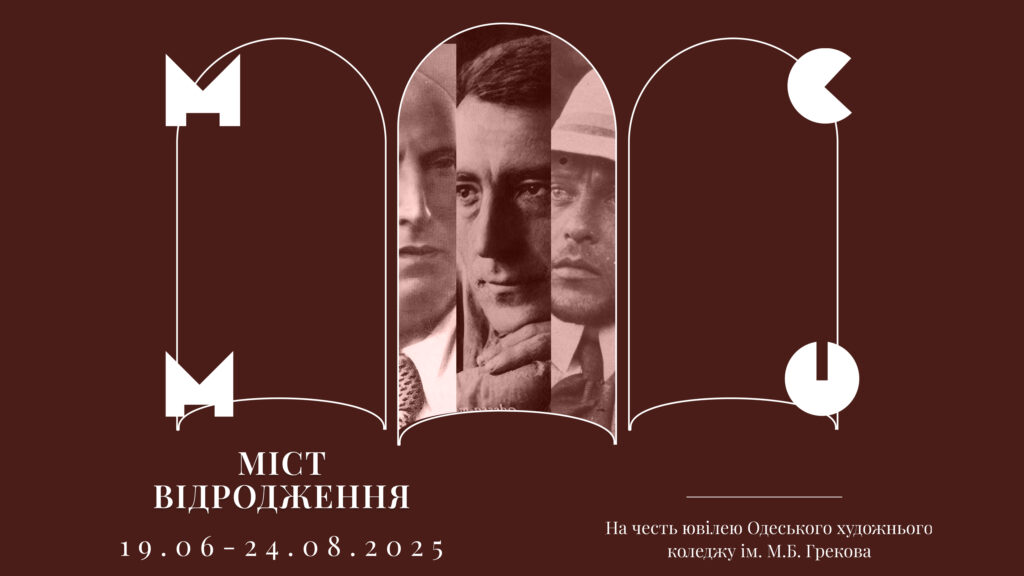
The exhibition consists of two parts:
- The first highlights the teachers who managed to preserve European modernist traditions under the pressure of totalitarianism.
- The second presents the work of graduates after 1991, when ideological restrictions vanished and space opened for new artistic languages.
This bridge is not only a metaphor of historical memory. It is a living structure held up by people, ideas, and art.
No matter what name it bore over the years — Academy, Institute, Polytechnic, or College — “Grekovka” always remained a bastion of artistic thought, a bridge between generations and cultural epochs.
Teachers — Bearers of Tradition
In critical moments of history, culture is saved by those who continue to create it — despite fear, prohibitions, and loss. Grekovka was fortunate to have teachers who not only preserved but enriched the European artistic tradition in its modernist expression:
- Teofil Fraierman — a refined Odesa Parisian, portraitist, and educator;
- Mykhailo Zhuk — a figure of Ukrainian romanticism, founder of the ceramics school, and guardian of the memory of the Executed Renaissance;
- Mykola Pavliuk — a Boichukist who preserved dignity and passed on honesty as an artistic value.
Alongside them worked Oleksii Shovkunenko, Pavlo Volokidin, Dina Frumina, and other artists who laid the foundation of the Odesa painting school.
A separate section of the exhibition is devoted to the legacy of Mykhailo Zhuk and his followers — college teachers and Odesa ceramists Dina Kliuvgant, Ivan Honcharenko, Oleksandr Dmytriiev, and co-curator Olena Zhernova.
Graduates — New Voices of Freedom
Since 1991, Ukraine has gained not only political independence but also the chance for artistic renewal. The opening of borders, the fall of censorship, and the emergence of new media triggered a creative surge. Students no longer sought permission — they searched for their own voice.
The graduates of Grekovka in recent decades are a generation raised in freedom. Their first student works and diploma projects already reflected the aesthetics of a new era, and their current pieces have entered the collections of leading museums.
We have illustrated this by comparing student works and diploma projects of post-1991 graduates with their current artworks from the MoOMA collection.
In developing the exhibition, the museum team realized just how many Grekovka graduates are among the most compelling and significant artists whose works are represented in the MCMO collection. The names differ, the styles vary — but they are united by Odesa, Grekovka, and a deep understanding that art is the language of freedom, spoken by the era.
This section is proof that the bridge has been built — and every day, new artists walk across it.